
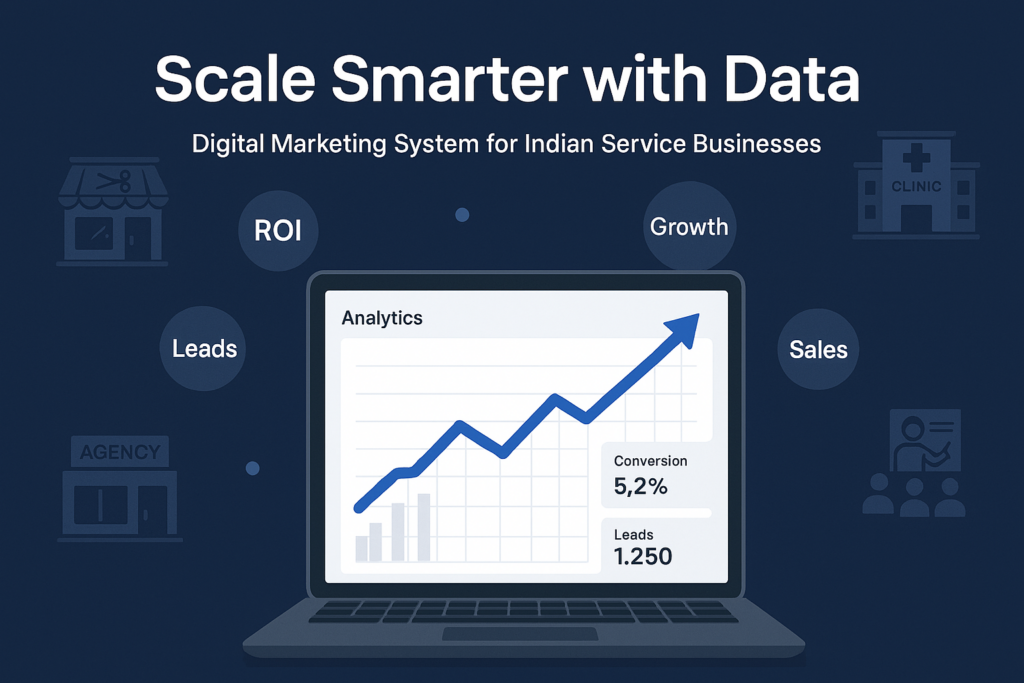
Most Indian service businesses struggle with one big problem.
They work hard.
They post on social media.
They run ads sometimes.
But they don’t know what is actually working.
They guess.
And guessing slows growth.
In 2026, guessing is dangerous.
Data wins.
If you want to scale your Indian service business — whether you run a digital agency, salon, coaching center, real estate firm, clinic, or consultancy — you need a data-driven digital marketing system.
Let’s break this down in a simple way.
What Is a Data-Driven Marketing System?
A data-driven system means:
You track numbers.
You study results.
You improve what works.
You stop what wastes money.
You don’t depend on luck.
You depend on proof.
Data shows you:
Where your leads come from
Which ads bring real customers
Which content creates trust
Where you lose potential clients
When you understand this, you grow faster.
Why Indian Service Businesses Must Focus on Data
India is highly competitive.
Every city has:
Multiple digital agencies
Many real estate agents
Dozens of coaching institutes
Hundreds of salons and clinics
If you market randomly, you waste money.
But if you track data:
You reduce cost per lead
You increase conversions
You improve customer experience
You scale profitably
Big brands already use data.
Now small and medium service businesses must do the same.
Step 1: Set One Clear Business Goal
Before collecting data, decide your main goal.
Do you want:
More leads?
More booked appointments?
More high-paying clients?
More repeat customers?
Choose one main goal.
For example:
If you run a clinic → Your goal may be more appointment bookings.
If you run a marketing agency → Your goal may be qualified leads.
Clear goal = clear tracking.
Step 2: Track Everything Properly
You cannot improve what you don’t measure.
Install proper tracking tools:
Google Analytics
Google Search Console
Meta Pixel (for Facebook & Instagram ads)
Conversion tracking for Google Ads
Track these numbers:
Website traffic
Source of traffic
Cost per lead
Conversion rate
Customer acquisition cost
Do this from day one.
Even small businesses must track numbers like professionals.
Step 3: Understand Where Your Best Leads Come From
Not all leads are equal.
Some people:
Ask for price only
Never respond again
Waste your time
But some:
Understand your value
Trust your brand
Pay quickly
Data helps you find your best source.
Maybe:
Google Ads gives fewer but better leads
Instagram gives more but low-quality leads
SEO gives long-term clients
When you know this, you invest more in what works.
Step 4: Build a Simple Funnel
A marketing funnel is the journey from stranger to customer.
Here is a simple funnel for Indian service businesses:
Awareness
People see your ad, reel, or blog.
Interest
They visit your website or profile.
Trust
They read reviews or watch testimonials.
Action
They call, fill a form, or book.
Track every step.
If many people visit but don’t contact you, improve your website.
If many contact but don’t convert, improve your sales process.
Data shows the weak point.
Fix the weak point.
Growth follows.
Step 5: Improve Conversion Rate
Most businesses focus only on traffic.
Traffic alone does not bring money.
Conversion does.
If 100 people visit your website and only 2 convert, your conversion rate is 2%.
If you improve it to 5%, your revenue increases without increasing traffic.
Improve conversion by:
Clear headline
Simple offer
Strong call-to-action
Customer testimonials
Fast loading speed
Easy contact options
Small changes bring big results.
Step 6: Use Retargeting Smartly
Most people do not buy the first time.
They visit.
They think.
They compare.
Retargeting helps you show ads again to people who visited your website or engaged with your content.
This works very well in India because:
Customers research before buying
Trust builds slowly
Retargeting reduces your cost per conversion.
It turns cold visitors into warm leads.
Step 7: Review Data Every Month
Do not check data once and forget it.
Make a monthly review habit.
Ask:
Which campaign gave the best ROI?
Which ad wasted money?
Which content got maximum engagement?
Where did leads drop?
Then take action.
Stop poor campaigns.
Improve average ones.
Scale the best ones.
This is how businesses grow steadily.
Step 8: Focus on Lifetime Value, Not Just One Sale
Smart service businesses think long term.
Instead of asking:
“How much did I earn from this lead?”
Ask:
“How much can this customer bring over 2–3 years?”
For example:
If one client pays ₹20,000 today but stays for 1 year, that value becomes ₹2–3 lakhs.
Data helps you understand:
Repeat purchase rate
Customer retention
Referral rate
When you know lifetime value, you can invest more confidently in marketing.
Common Mistakes Indian Service Businesses Make
Let’s be honest.
Many businesses:
Run ads without tracking
Post content without strategy
Change strategy every week
Stop ads too early
Ignore website optimization
Avoid these mistakes.
Follow a system.
Trust the process.
Track results patiently.
Final Thoughts
A data-driven digital marketing system is not complicated.
It is simple.
Set a goal.
Track numbers.
Study results.
Improve continuously.
Stop guessing.
Start measuring.
Indian service businesses that use data will:
Spend less
Earn more
Scale faster
Build long-term brands
You don’t need a huge budget.
You need clarity.
You need discipline.
You need a system.
When you combine smart strategy with real data, scaling becomes predictable.
And predictable growth builds powerful businesses.
