AI

Data-Driven Digital Marketing System for Scaling Indian Service Businesses

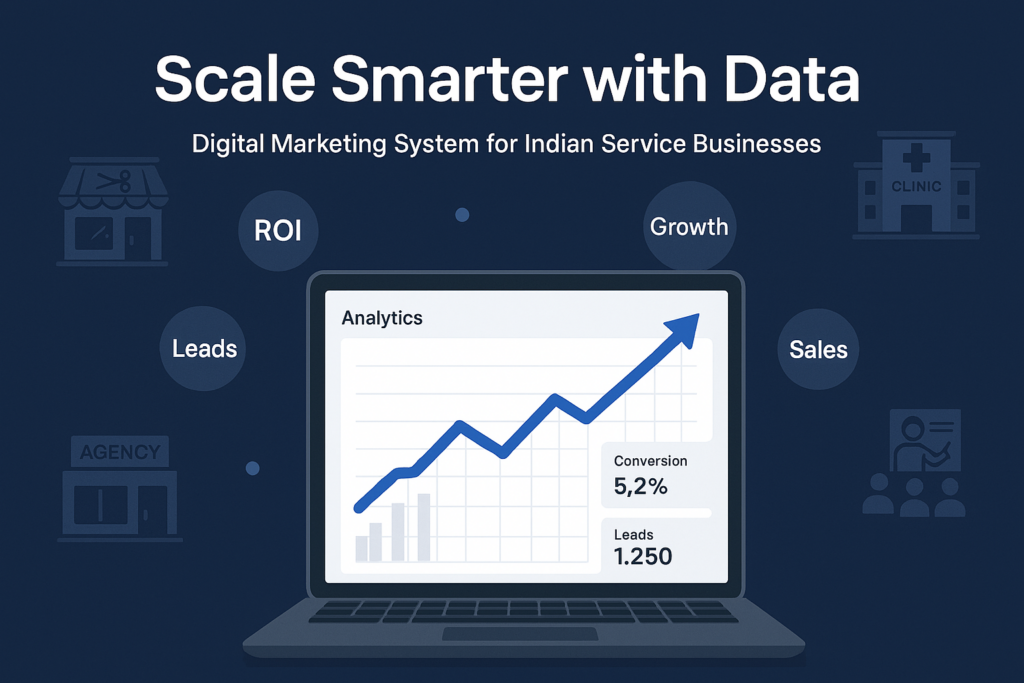
Most Indian service businesses struggle with one big problem. They work hard. They post on social media. They run ads sometimes. But they don’t know what is actually working. They guess. And guessing slows growth. In 2026, guessing is dangerous. Data wins. If you want to scale your Indian service business — whether you run a digital agency, salon, coaching center, real estate firm, clinic, or consultancy — you need a data-driven digital marketing system. Let’s break this down in a simple way.   What Is a Data-Driven Marketing System? A data-driven system means: You track numbers. You study results. You improve what works. You stop what wastes money. You don’t depend on luck. You depend on proof. Data shows you: Where your leads come from Which ads bring real customers Which content creates trust Where you lose potential clients When you understand this, you grow faster. Why Indian Service Businesses Must Focus on Data India is highly competitive. Every city has: Multiple digital agencies Many real estate agents Dozens of coaching institutes Hundreds of salons and clinics If you market randomly, you waste money. But if you track data: You reduce cost per lead You increase conversions You improve customer experience You scale profitably Big brands already use data. Now small and medium service businesses must do the same.   Step 1: Set One Clear Business Goal Before collecting data, decide your main goal. Do you want: More leads? More booked appointments? More high-paying clients? More repeat customers? Choose one main goal. For example: If you run a clinic → Your goal may be more appointment bookings. If you run a marketing agency → Your goal may be qualified leads. Clear goal = clear tracking.   Step 2: Track Everything Properly You cannot improve what you don’t measure. Install proper tracking tools: Google Analytics Google Search Console Meta Pixel (for Facebook & Instagram ads) Conversion tracking for Google Ads Track these numbers: Website traffic Source of traffic Cost per lead Conversion rate Customer acquisition cost Do this from day one. Even small businesses must track numbers like professionals.   Step 3: Understand Where Your Best Leads Come From Not all leads are equal. Some people: Ask for price only Never respond again Waste your time But some: Understand your value Trust your brand Pay quickly Data helps you find your best source. Maybe: Google Ads gives fewer but better leads Instagram gives more but low-quality leads SEO gives long-term clients When you know this, you invest more in what works.   Step 4: Build a Simple Funnel A marketing funnel is the journey from stranger to customer. Here is a simple funnel for Indian service businesses: Awareness People see your ad, reel, or blog. Interest They visit your website or profile. Trust They read reviews or watch testimonials. Action They call, fill a form, or book. Track every step. If many people visit but don’t contact you, improve your website. If many contact but don’t convert, improve your sales process. Data shows the weak point. Fix the weak point. Growth follows.   Step 5: Improve Conversion Rate Most businesses focus only on traffic. Traffic alone does not bring money. Conversion does. If 100 people visit your website and only 2 convert, your conversion rate is 2%. If you improve it to 5%, your revenue increases without increasing traffic. Improve conversion by: Clear headline Simple offer Strong call-to-action Customer testimonials Fast loading speed Easy contact options Small changes bring big results. Step 6: Use Retargeting Smartly Most people do not buy the first time. They visit. They think. They compare. Retargeting helps you show ads again to people who visited your website or engaged with your content. This works very well in India because: Customers research before buying Trust builds slowly Retargeting reduces your cost per conversion. It turns cold visitors into warm leads.   Step 7: Review Data Every Month Do not check data once and forget it. Make a monthly review habit. Ask: Which campaign gave the best ROI? Which ad wasted money? Which content got maximum engagement? Where did leads drop? Then take action. Stop poor campaigns. Improve average ones. Scale the best ones. This is how businesses grow steadily.   Step 8: Focus on Lifetime Value, Not Just One Sale Smart service businesses think long term. Instead of asking: “How much did I earn from this lead?” Ask: “How much can this customer bring over 2–3 years?” For example: If one client pays ₹20,000 today but stays for 1 year, that value becomes ₹2–3 lakhs. Data helps you understand: Repeat purchase rate Customer retention Referral rate When you know lifetime value, you can invest more confidently in marketing.   Common Mistakes Indian Service Businesses Make Let’s be honest. Many businesses: Run ads without tracking Post content without strategy Change strategy every week Stop ads too early Ignore website optimization Avoid these mistakes. Follow a system. Trust the process. Track results patiently.   Final Thoughts A data-driven digital marketing system is not complicated. It is simple. Set a goal. Track numbers. Study results. Improve continuously. Stop guessing. Start measuring. Indian service businesses that use data will: Spend less Earn more Scale faster Build long-term brands You don’t need a huge budget. You need clarity. You need discipline. You need a system. When you combine smart strategy with real data, scaling becomes predictable. And predictable growth builds powerful businesses.

Data-Driven Digital Marketing System for Scaling Indian Service Businesses Read More »
Performance Marketing Agency for High Revenue Businesses in India

Performance Marketing Agency for High-Revenue Businesses in India Scale Faster. Spend Smarter. Earn More.   High-revenue businesses in India face a different challenge.   You already make good money. You already run ads. You already have a marketing team. But now you want to scale. You want predictable growth. You want better returns on ad spend. You want every rupee to work harder. This is where a performance marketing agency becomes important. Not a normal marketing agency. A performance-driven agency. Let’s understand why.   What Is Performance Marketing? Performance marketing focuses on results. You do not pay for effort. You pay for performance. The agency tracks: Leads Sales Revenue Cost per acquisition Return on ad spend (ROAS) Every campaign has a clear goal. Every rupee is tracked. Every decision is based on data. This model works best for businesses that already generate strong revenue and want to grow faster. Why High Revenue Businesses Need a Performance Marketing Agency If your business already makes good revenue, your problems are different from small startups. You may face: Rising ad costs Lower conversion rates High competition Scaling challenges Poor tracking systems Many brands waste lakhs of rupees because they scale without strategy. A performance marketing agency solves this. It builds systems. It tracks data properly. It optimizes continuously. The goal is simple: Increase profit, not just traffic. How a Performance Marketing Agency Helps You Scale 1. Clear Revenue-Focused Strategy The agency does not start with ads. It starts with numbers. It checks: Your current revenue Your profit margins Your customer acquisition cost Your average order value Then it creates a scaling plan. Without numbers, scaling becomes risky. With numbers, scaling becomes predictable.   2. Smart Paid Advertising High revenue businesses cannot rely only on organic growth. They need structured paid campaigns. A performance marketing agency runs: Google Search Ads for high-intent buyers Display and remarketing ads Social media conversion campaigns Shopping ads for e-commerce brands But the focus stays on conversions. Not likes. Not followers. Not impressions. Only revenue matters. 3. Conversion Rate Optimization Traffic alone does not grow revenue. Your website must convert visitors into buyers. An agency improves: Landing pages Product pages Call-to-action buttons Checkout process Page speed Even a small improvement in conversion rate can increase revenue massively. For example: If you increase your conversion rate from 2% to 3%, your revenue can grow by 50% without increasing traffic. That is the power of optimization.   4. Data Tracking and Analytics Many Indian businesses run ads without proper tracking. This leads to confusion. A performance marketing agency sets up: Conversion tracking Google Analytics Ad pixels Event tracking Revenue attribution Now you can see: Which ad generates sales Which keyword brings high-value customers Which platform gives better ROI Clear data removes guesswork.   5. Continuous Testing and Scaling Scaling does not mean increasing budget blindly. A performance agency tests: Different ad creatives Different headlines Different offers Different audiences It keeps what works. It removes what fails. Then it increases budget on winning campaigns. This method reduces risk and increases profit. Why This Matters in India The Indian market is growing fast. More people shop online. More brands enter the market. Ad competition increases daily. If you do not optimize, you fall behind. High revenue brands in India now compete nationally, not just locally. You compete with: Big D2C brands Funded startups Established players To win, you need precision marketing. Not random marketing. Signs You Need a Performance Marketing Agency You should consider hiring one if: Your monthly ad spend is above ₹1 lakh Your ROAS is inconsistent Your cost per lead is rising You do not know which channel gives best results Your internal team struggles with scaling High revenue businesses should not depend on trial and error. They need experts who understand scaling. What to Look for in a Performance Marketing Agency Not all agencies focus on performance. Choose one that: Talks about revenue, not just traffic Shows real case studies Works with clear KPIs Provides transparent reporting Optimizes regularly Ask them: “How will you improve my profitability?” If they cannot answer clearly, move on. The Real Goal: Profitability, Not Popularity Many businesses chase visibility. They want more followers. More engagement. More impressions. But visibility does not pay salaries. Revenue does. A strong performance marketing agency focuses on: Profit margins Lifetime value Customer retention Scalable systems When you focus on profitability, growth becomes sustainable. Long-Term Impact on Your Business When you work with the right performance marketing agency, you build: Predictable lead flow Stable customer acquisition system Clear revenue tracking Scalable ad structure Strong market position You stop guessing. You start growing with confidence. Instead of asking, “Will this month be good?” You start planning growth quarters ahead. Final Thoughts High revenue businesses in India cannot rely on basic marketing anymore. They need structure. They need data. They need performance. A performance marketing agency helps you: Reduce waste Improve ROI Scale safely Increase profit If your business already generates strong revenue, the next step is not more effort. The next step is smarter strategy. Scale with numbers. Optimize with data. Grow with confidence. That is the power of performance marketing.

Performance Marketing Agency for High Revenue Businesses in India Read More »

Zero Budget Digital Marketing Strategy for Small Businesses in India

Many small business owners in India believe they need a big budget to grow online. They think digital marketing means expensive ads, costly agencies, and large monthly investments. This belief stops many businesses from even starting.   The truth is simple. You do not need money to start digital marketing. You need time, consistency, and the right strategy. If you run a salon, gym, coaching center, clothing store, bakery, or digital service business, you can grow online without spending money. You only need to use free tools and focus on smart actions. Let us understand how you can build a zero-budget digital marketing strategy that actually works in India.   First, you must understand your customer. Many small businesses make the mistake of promoting their services without knowing who they want to target. You should clearly define your ideal customer. Think about their age, location, income level, and problems. When you understand their problems, you can create content that speaks directly to them. When people feel understood, they trust you.   Next, create a strong Google Business Profile. This is one of the most powerful free tools available for Indian small businesses. When people search for services near them, Google shows local businesses first. If your profile is complete and active, you increase your chances of appearing in local search results. Add your correct phone number, address, working hours, and real photos. Ask your happy customers to leave honest reviews. Reviews build trust quickly. In India, people trust reviews more than advertisements.   Now focus on content. Content is your biggest asset when you have zero budget. You can create helpful posts on Instagram, Facebook, or LinkedIn. You can write simple blog articles on your website. You can even create short videos using your smartphone. Do not worry about professional cameras or expensive editing. Speak clearly. Share useful information. Answer common questions. Teach something simple related to your industry. When you educate your audience, you build authority.   Consistency matters more than perfection. Many business owners post for one week and then stop. Digital growth takes time. If you post three to four times every week for three months, you will see results. Social media platforms reward active creators. Your visibility increases slowly but steadily.   Search Engine Optimization, also called SEO, is another powerful zero-budget strategy. SEO means optimizing your website so it appears on Google when people search for related services. You can start by using simple keywords that people search for in India. For example, if you run a bakery in Delhi, you can write articles like “Best Birthday Cakes in Delhi” or “Affordable Custom Cakes in Delhi.” Use your city name naturally in your content. This helps Google understand your location and show your website to nearby users.   You should also focus on WhatsApp marketing. In India, almost everyone uses WhatsApp daily. You can create a WhatsApp Business account for free. Add your business description, product catalog, and contact details. When customers message you, respond quickly. Quick replies create a professional impression. You can also send updates to customers who agree to receive messages. Do not spam people. Only send useful information or special offers.   Email marketing also works well, even with zero budget. Many free tools allow you to collect emails and send newsletters. When someone visits your website, offer them something valuable. You can give a free guide, discount code, or helpful checklist. In exchange, ask for their email address. Once you build an email list, you can stay connected with potential customers. Email helps you build long-term relationships.   Personal branding plays a big role in 2026. People trust people more than logos. If you are the business owner, show your face. Share your journey. Talk about your challenges and achievements. Record short videos explaining your services. When customers see the real person behind the brand, they feel more comfortable doing business with you.   Networking also helps in zero-budget marketing. Connect with other local business owners. Collaborate with them. For example, a gym can collaborate with a nutritionist. A salon can collaborate with a makeup artist. You can promote each other’s services online. This increases reach without spending money.   Another important strategy is to join local Facebook groups and community forums. Many Indian cities have active groups where people ask for recommendations. Participate genuinely. Do not spam your services. Answer questions and provide helpful advice. When people see your helpful comments regularly, they remember your name. Later, when they need your service, they contact you.   You should also focus on improving customer experience. Happy customers become free marketers for your business. When you deliver excellent service, customers recommend you to friends and family. Word-of-mouth marketing still works strongly in India. Encourage satisfied customers to share their experience online. Ask them to tag your business on social media.   Time management is important in zero-budget marketing. Since you are not spending money, you are investing time. Create a simple weekly schedule. Decide which days you will create content and which days you will respond to comments and messages. Discipline helps you stay consistent.   Many business owners give up because they do not see instant results. Remember that zero-budget marketing is slow but powerful. It builds long-term trust and organic visibility. When you grow organically, your business becomes stable. You do not depend fully on paid advertisements.   The biggest advantage of zero-budget digital marketing is learning. When you handle your marketing yourself, you understand your audience better. You learn what type of content works. You discover which platform brings more leads. This knowledge helps you make smarter decisions in the future, even when you decide to invest money.   In India, digital users are increasing every year. Small towns and cities are becoming more active online. This creates a huge opportunity for small businesses. If you start today and stay consistent, you can build a strong online presence without spending a single rupee.   You do not need

Zero Budget Digital Marketing Strategy for Small Businesses in India Read More »

Digital Marketing Strategy for Small Businesses in 2026

Digital Marketing Strategy for Small Businesses in 2026   A Simple Plan to Get More Customers and Grow Faster Running a small business in 2026 is not easy. Competition is high. Customers have many options. Most people search online before they buy anything. They check Google. They read reviews. They compare prices. If your business does not show up online, you lose customers. But don’t worry. You don’t need a big budget. You need a clear and simple strategy. Let’s understand what really works in 2026.   1. Start With One Clear Goal Do not try to do everything at once. First, decide what you want. Do you want: More phone calls? More website leads? More store visits? More online sales? Pick one main goal. When you focus on one goal, you get better results. For example: If you want more local customers, → Focus on local SEO. If you want more sales, → Focus on ads and landing pages. Clear goal. Clear plan. Better results.   Step 2: Turn Your Website Into a Sales Machine In 2026, your website is not just a brochure. It’s your 24/7 salesperson. Ask yourself honestly: Does my website load in under 3 seconds? Is it mobile-friendly? Is my offer clear? Is there a strong call-to-action? Do I show reviews or testimonials? If not, visitors will leave — and they won’t come back. A high-converting website must have: âś” A strong headline that solves a problem âś” Clear benefits (not just features) âś” Social proof (reviews, case studies) âś” Simple contact options (form, WhatsApp, call button) âś” SEO optimization Traffic without conversions is just vanity.   Step 3: Dominate Local SEO (Game-Changer for Small Businesses) Imagine someone searching: “Best digital marketing agency near me”“Top salon in Mumbai”“Affordable gym in Delhi” If your business appears in the top 3 results, you win. Local SEO is one of the highest ROI strategies in 2026. To dominate local search: Optimize your Google Business Profile completely Add real photos regularly Collect 5-star reviews Use location-based keywords Maintain consistent contact details everywhere More reviews = More trustMore trust = More callsMore calls = More revenue Simple. Step 4: Use AI Smartly (But Don’t Depend Fully on It) AI tools in 2026 are powerful. They can help you: Write blogs Generate ad copies Create captions Analyze competitors Suggest keywords But remember: AI helps with speed. Strategy comes from YOU. Focus on creating helpful content: “How-to” guides Problem-solving articles Case studies Industry tips Customer success stories Google now rewards content that shows experience and real value. If your content genuinely helps, people will trust you.   Step 5: Run Paid Ads — But Strategically Organic growth is powerful but slow. Paid ads give immediate visibility. Best-performing platforms in 2026: Google Ads → High buying intent Instagram & Facebook Ads → Brand building + retargeting YouTube Ads → Authority + trust But don’t waste money boosting random posts. Instead: âś” Create a clear offer âś” Use a dedicated landing page âś” Install tracking pixels âś” Retarget interested visitors âś” Optimize weekly Even a small budget can generate a strong ROI — if managed correctly.   Step 6: Social Media That Builds Trust (Not Just Likes) In 2026, people don’t buy from pages. They buy from brands they trust. Stop focusing only on: ❌ Random quotes ❌ Irrelevant reels ❌ Trend chasing Instead, create: âś” Behind-the-scenes content âś” Customer testimonials âś” Before & after results âś” Educational short videos âś” FAQs Short-form videos dominate attention. But value-driven videos dominate conversions.   Step 7: Don’t Ignore Email Marketing Many small businesses ignore email marketing because it feels “old.” Big mistake. Email marketing still delivers one of the highest ROI among all digital channels. Use email to: Welcome new leads Send offers Share updates Follow up with prospects Nurture long-term relationships Automate: âś” Welcome sequence âś” Reminder emails âś” Follow-ups âś” Monthly newsletters Your email list is your digital asset. Social media followers can disappear. Email subscribers stay.   Step 8: Track Everything (Data = Power) Digital marketing without tracking is guessing. Track: Website traffic Cost per lead Conversion rate Ad performance Revenue from campaigns Review performance monthly. Ask: What’s working? What’s wasting money? Where should I invest more? The businesses that analyze data grow faster than those that rely on assumptions.   Step 9: Build Your Personal Brand In 2026, people connect with people. If you’re a founder or small business owner: Share your journey Show your expertise Post insights Speak about industry trends Share customer wins When customers trust YOU, they trust your business. Personal branding builds long-term authority.   90-Day Growth Plan for Small Businesses Month 1: Optimize website Set up SEO basics Improve Google Business Profile Month 2: Launch paid ads Post valuable content consistently Start collecting reviews Month 3: Analyze performance Scale winning ads Publish 4 SEO blogs Launch email automation Consistency wins. Always.   Final Thoughts: 2026 Is Full of Opportunity Digital marketing in 2026 is not about doing everything. It’s about doing the right things consistently. Small businesses that: âś” Focus on strategy âś” Use AI smartly âś” Invest in trust âś” Balance paid + organic âś” Track performance Will outperform competitors — even with smaller budgets. If you take action now, your business won’t just survive in 2026. It will dominate.

Digital Marketing Strategy for Small Businesses in 2026 Read More »